
Selling your boat can feel overwhelming, especially if you are not familiar with the market. From...
Realities of Navigating the Modern Boat Market
The siren call of the open water is a powerful intoxicant. It promises a lifestyle of horizon lines, absolute freedom, and the quiet prestige of a well-found vessel. But for those looking to deploy significant capital, the transition from dreamer to owner is often a navigational nightmare. In an era where the internet suggests every transaction is just a "click and buy" away, the marine market remains a treacherous archipelago of legal reefs and financial shoals.
Making an investment without a professional guide isn’t just brave; it’s often a recipe for a "DIY voyage" that ends in a salvage operation. As a veteran of these waters, I can tell you that the anxiety of a massive financial outlay is real, but the curiosity surrounding why "going it alone" is so difficult is easily answered: the modern market is designed to protect those within the professional ecosystem, leaving the DIYer exposed to the elements.
The "Invisible" Legal Shield: Your Broker
In a private transaction, the seller’s only obligation is to their own bank balance. In the professional arena, however, an accredited broker operates under a "vertical relationship." This isn't just a fancy industry term; it is an obligation from the broker to the client.
In my years of consulting, I’ve found the BIA’s stance on the self-serving nature of transactions to be the ultimate reality check:
"The relationship imposes duties on people in a situation of responsibility... based on the idea that people are self-serving."
A professional broker is legally barred from accepting "secret commissions" or bribes. If a conflict does arise—for instance, if a broker has a partner building the very boats they are recommending—they must obtain your "fully informed consent" as a defence against a breach of duty. Furthermore, DIYers often stumble into the "Effective Cause" doctrine. This legal reality means that if a broker makes the initial introduction between a buyer and seller, they may be entitled to a commission even years later when the boat finally sells. Going DIY doesn't always mean you've escaped the bill; it just means you haven't planned for it.
The "Ghost" Title: Why Your New Boat Might Belong to a Bank
The most chilling story in yachting isn't a storm at sea; it’s the "ghost" title. It is entirely possible to pay for a vessel in full, take the keys, and discover weeks later that the boat was never truly yours. Without professional due diligence, a buyer may unknowingly inherit "fixed and floating charges"—liens, mortgages, or unpaid marina bills that stay with the hull. In the worst-case scenario, a finance company can repossess the vessel with no recourse for the new owner.
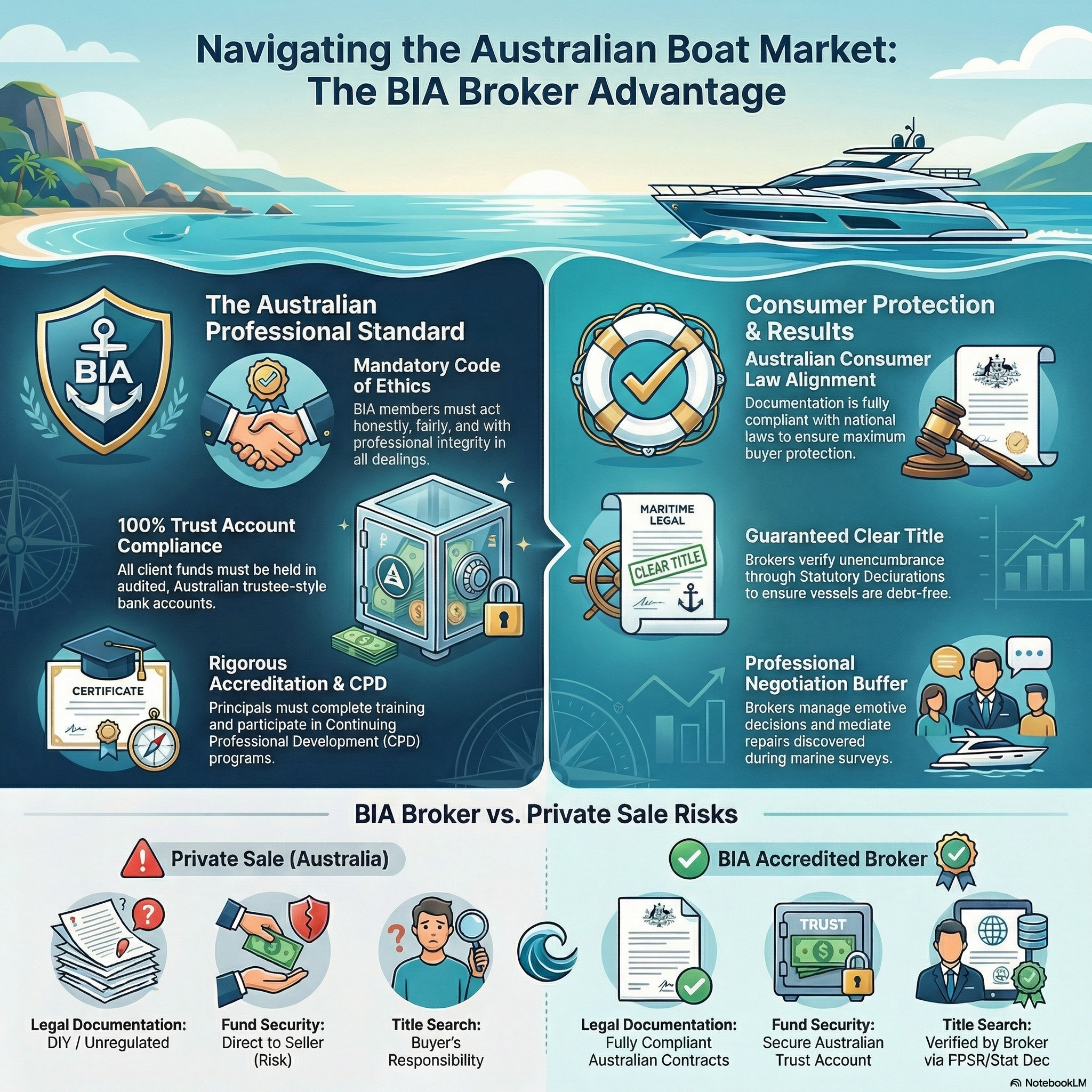
To prevent a buyer from being "left high and dry," a professional broker acts as a "conveyance" for title. They utilise specialised "trust accounts" for all deposits, ensuring funds are never held by the vendor prematurely. Most importantly, an accredited broker will insist on a Statutory Declaration (BIA 6.4.14). This is a critical, legally binding document where the vendor declares the vessel is unencumbered. Without this specific paperwork, you are essentially taking a million-dollar gamble on a stranger’s word.
"[Buyers are] left high and dry and without what they thought was their vehicle to deliver their ultimate lifestyle experiences."
The 10% Math: Why Paying Commission Actually Saves You Money
There is an "ignorant" view—to borrow a term from the frontline—that a 10% commission is pure, unearned profit. From a consultant's perspective, this fee is a "reasonable protection" that covers the massive logistical and liability burden of the sale. Professional brokers achieve higher net prices by removing the volatile element of emotion from the negotiation and providing access to "broker-only" sites and platforms like YachtWorld that individuals simply cannot access.
The most overlooked value, however, is Professional Indemnity (PI) and Public Liability Insurance. If a DIY seller describes their vessel as a "go-anywhere boat" and it subsequently founders in the Southern Ocean, that seller is personally liable for the misdescription of the vessel’s particulars. An accredited broker’s PI insurance acts as a safety net for these errors. When you pay a commission, you aren't just paying for a listing; you are paying for a multi-page specification sheet, liability mitigation, and the professional "deniability" that keeps you out of court.
"A quality boat broker works a lot harder than a real estate broker... we are selling more of a want item compared to more of a need item."
The Professional "Buffer": Saving You from the "Million-Dollar Nibble"
Selling a luxury vessel is an emotional and logistical gauntlet. For an owner, "zero nibbles" for weeks can lead to desperate, "shady deals." Private listings often attract "tire-kickers" or unqualified callers who waste hours of your time. At the $1 million-plus level, smart buyers almost never buy directly from an owner; they perceive it as too risky and lack the professional framework that ensures a deal is "legit."
A broker acts as a vital buffer, pre-screening prospects before they ever step on your teak. This isn't just about convenience; it’s about safety. Industry insiders still whisper about the tragic cases—like the couple murdered by "buyers" during a DIY yacht sale—that highlight why high-net-worth individuals value the broker’s role in vetting and accompanying every inspection. The broker removes the friction, allowing you to walk away from a "million-dollar nibble" without the stress of a personal confrontation.
Beyond the Handover: The Environmental and Educational Legacy
In a professionalised industry, the relationship doesn't end when the funds clear. A BIA-accredited sale includes "tuition, support, and guidance" to integrate the new owner into the boating lifestyle safely. This educational aspect is crucial for the longevity of the vessel and the safety of the crew.
Moreover, professional brokers operate under a strict Code of Ethics regarding environmental stewardship. They don't just hand over keys; for environmental concerns, covering everything from preventing fuel spills and noise pollution to protecting the clean water that is the foundation of the sport. By choosing an accredited broker, you are ensuring that your legacy as an owner is one of responsibility rather than negligence.
Conclusion: The Future of the Voyage
The marine industry is shifting rapidly toward higher accreditation and self-regulation. As government bodies increase their monitoring of fair trading and safety, the gap between the professional market and the DIY "mirage" is only widening. Professionalism is the only way to ensure the process of buying or selling doesn't detract from the ultimate goal: the enjoyment of the water.
In an era where you can buy almost anything with a click, is your peace of mind worth the risk of a DIY voyage, or is some expertise the only true way to clear water?